Ellen Futterman, Editor-in-Chief
Published March 11, 2026
At nearly 97 years old, Elsie Shemin-Roth does not mince words, or energy. She pounds the table for emphasis, wears a red, white and blue hat and displays an Uncle Sam doll as part of her “whole deal,” and routinely earns standing ovations.
But the force behind her presence is not theatrical. It is moral. For nearly three decades, Shemin-Roth has been on a mission rooted in a love for her father and fueled by a refusal to let antisemitism — past or present — go unanswered.
Today, that mission is less about a long ago battlefield and more about the one she believes exists in classrooms, neighborhoods and civic life across America.
Shemin-Roth’s father, Sgt. William Shemin, was a World War I hero whose bravery went unrecognized after the war, an omission Shemin-Roth later came to understand as rooted in systematic antisemitism. In 2002, after reading that the Department of Defense would review Medal of Honor citations for Jewish soldiers from later wars, she asked a simple question: “What about World War I?”
A family photograph of Elsie Roth’s father, Sgt. William Shemin, who risked his life on the battlefield to save soldiers in his unit in August 1918.
That question led to a 13-year effort that included congressional legislation extending the review to World War I soldiers. Ultimately, 50 cases were examined. Only one advanced through every level of scrutiny.
In 2015, Shemin-Roth received an unexpected phone call.
“This is Barack Obama,” the voice said.
At a White House ceremony later that year, her father was posthumously awarded the Medal of Honor, an acknowledgment of both his valor and the injustice that had delayed it for nearly a century.
For many families, that would have been the final chapter. For Shemin-Roth, who earned a nursing degree at age 54 and is a member of Congregation Shaare Emeth, it was a call to action.
In the years since, she has transformed her father’s story into a platform to confront contemporary antisemitism and civic complacency. She travels to synagogues, churches, community centers and schools, speaking not only about a century-old injustice but about what she sees unfolding now.
“Antisemitism didn’t end with my father,” Shemin-Roth tells audiences. “It’s everywhere.”
She speaks of Jewish students who hesitate to wear a Star of David on campus. She points to immigrants treated with suspicion rather than welcomed as contributors — echoes, she says, of the barriers her family once faced. She warns about the normalization of hateful rhetoric and the danger of silence.
Her presentations are designed to move people beyond empathy. Shemin-Roth does not let audiences leave merely inspired; she challenges them to refuse to stay passive. She urges them to act specifically and persistently:
Call your elected officials. If at first you don’t get through, keep at it. Be clear about what concerns you. Write letters to the editor. Organize friends and family. Mobilize with signs. Hit the streets, airports, state capitols. Show up visibly, even if it’s just on your own front porch.
She also brings materials from more than a dozen organizations, including the League of Women Voters, the American Red Cross, AARP and the Urban League, encouraging those with both time and conviction to channel their concern into volunteer work and civic engagement.
“You can’t keep kvetching,” she says. “The time is now to do something.”
Shemin-Roth is careful to frame her message around values rather than party affiliation. She speaks about antisemitism, racism and democracy as moral issues, not political talking points. Citizenship, she insists, requires participation. Silence is not neutrality; it is permission.
Audience members often approach her afterward, surprised by her stamina and directness. Some tell her they have begun making phone calls or initiating conversations they had long avoided. Others say they had never considered how antisemitism past and present connect so clearly. That response, Shemin-Roth says, is how she measures impact.
At this stage of her life, getting from place to place can be challenging, so Shemin-Roth relies on others for help with driving and logistics. Jewish Light Unsung Hero Wendy Flusser (class of 2024) frequently accompanies her, assisting with travel as well as with the displays and materials tied to her father’s recognition, including a book about his life, “The Ivy Hero: The Brave Life of Sergeant William Shemin.” Proceeds from the book benefit “Dogs for Our Brave,” which provides service dogs to veterans in need of emotional and physical healing.
An animal lover herself, Shemin-Roth ran a nonprofit rescue operation for 14 years, helping to save more than 4,000 animals.
Now she is lining up speaking engagements to expand her outreach. When we spoke last week, she was coordinating with Rabbi Lori Levine at Shaare Emeth, preparing to address more than two dozen children there.
Organizations interested in her presentation — which she offers free of charge — can contact Shemin-Roth at 314-279-1379 or at elsieshemin@gmail.com.
For Shemin-Roth, her father’s medal is not the end of a story. It is proof that injustice can be confronted, and a sobering reminder that the fight against antisemitism and racism never really ends.
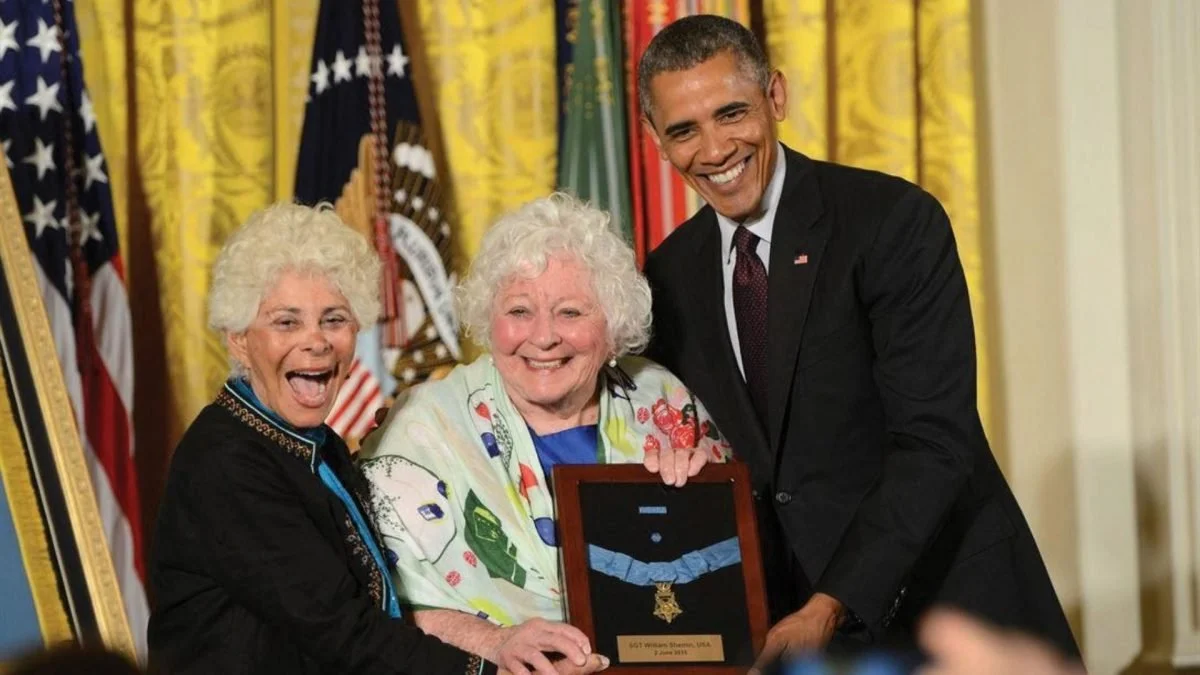
President Barack Obama presents Ina Bass, left, and Elsie Shemin-Roth with the Medal of Honor for their father, Army Sgt. William Shemin, at the White House in 2015. Sgt. Shemin was recognized for risking his life during World War I to save the lives of others.
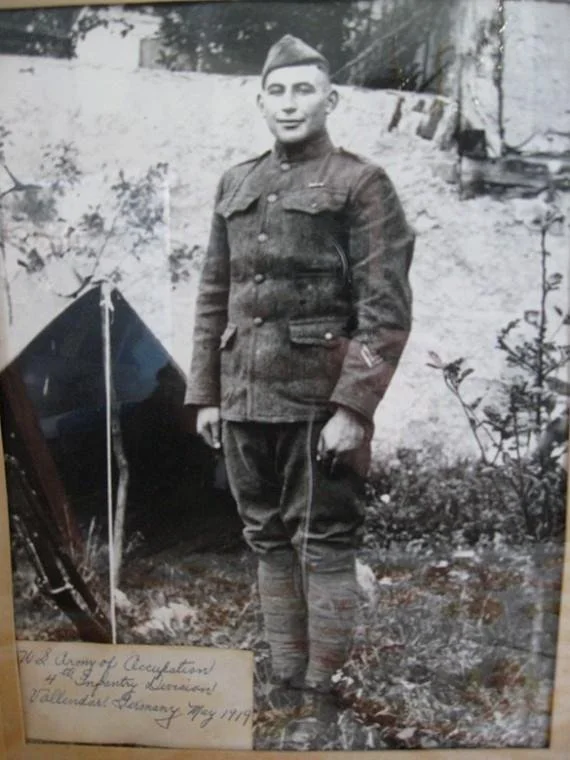
A family photograph of Elsie Roth’s father, Sgt. William Shemin, who risked his life on the battlefield to save soldiers in his unit in August 1918.